
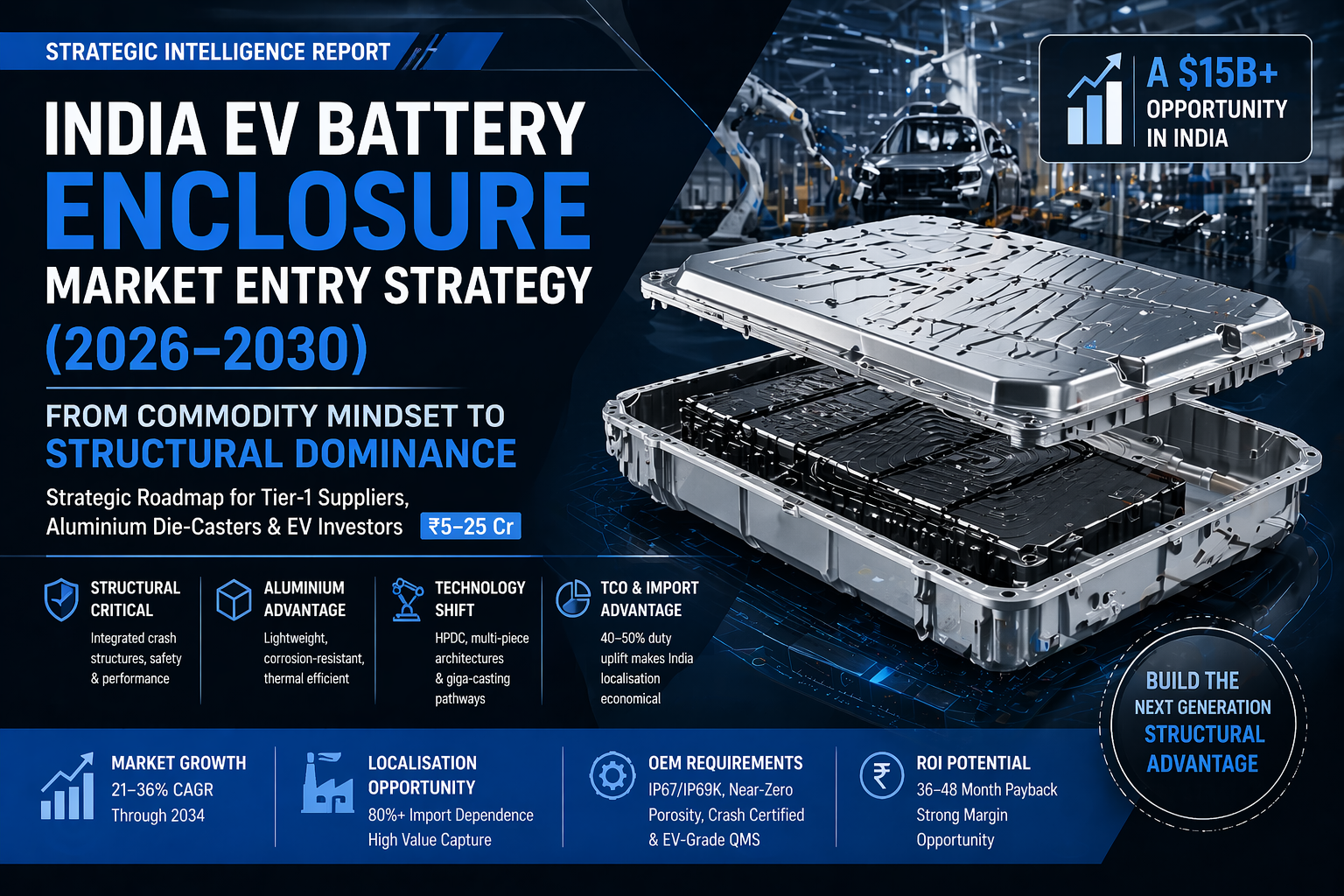
🚗 Strategic Intelligence: EV Battery Enclosures Are No Longer Commodity
The Indian EV battery enclosure market is undergoing a structural shift — from sheet-metal fabrication to aluminium-intensive, safety-critical systems integrated into vehicle architecture.
Yet most suppliers remain stuck in low-value manufacturing, while OEM expectations have already moved toward:
- ⚡ Crash-integrated structures
- 💧 IP-grade sealing (IP67/IP69K)
- 🔬 Near-zero porosity castings
👉 This report answers one critical question:
Where is the real money in EV enclosures — and how do you enter without burning capital?
📊 What You’ll Learn
- 🧱 Material Reality: Why aluminium dominates and magnesium remains niche
- 🏭 Giga-Casting Myth vs India Reality: Why India cannot replicate Tesla yet — and what works instead
- 🌏 Import Dependency Gap: 80%+ reliance on imports → localisation opportunity
- 💰 TCO Advantage: 40–50% import duty stack flips economics in favour of local players
- 🛠️ OEM Requirements: Sealing, porosity, crash performance, IP standards
- ⚠️ Tier-1 Capability Gaps: Where Indian suppliers fail to meet EV-grade expectations
- 🚀 Entry Strategy: Multi-piece aluminium architectures vs giga-casting pathways
🎯 Who This Is For
- 🏭 Aluminium die-casters & HPDC manufacturers
- 🚗 Automotive Tier-1 suppliers
- 💼 EV component investors (₹5–25 Cr range)
- 🔗 OEM-linked manufacturing companies
🚫 Who Should NOT Buy
- ❌ General traders or distributors
- ❌ Low-capex sheet metal fabricators
- ❌ Companies not targeting OEM supply chains
💡 Core Insight
👉 EV enclosures are not boxes — they are structural systems.
And companies that fail to upgrade to:
- ⚙️ Aluminium HPDC
- 💧 Advanced sealing systems
- 📋 OEM-grade QMS
👉 Will be permanently locked out of the EV value chain.
📦 Deliverables
- 📑 50+ Slide Strategic Intelligence Deck (PDF)
- 📊 Entry Strategy + Capability Gap Mapping
- 🏭 OEM & Tier-1 Benchmark Insights
⚡ This is not a report. It’s a decision-making tool.
Reviews
There are no reviews yet.